
The Arcadian Accord
A living agreement between people and land, rooted in Natural Law, kinship, and shared responsibility.
What is the arcadian accord?
A guide for a different kind of village, where people go to remember who we are, and what we came here to do.
A living social contract
It sets out how people in Arcadia live, work, govern, and relate to each other. It is not enforced by force, but by shared values and clear structure.
Built for ordinary people, not perfect ones
It assumes human beings can learn, take responsibility, and grow into stewardship when given a sane framework.
Rooted in land and kin, not ideology
The Accord begins with the land, then family, then tribe, then wider community. Hierarchies of race, class, and gender have no place here. Worth is measured by action, word, and contribution to the whole.
One land. One people. One shared future.
The Five Foundations
-
Live in accordance with the patterns and limits of the Earth. Avoid actions that disrupt natural cycles. Decisions are based on what is real and sustainable, not what is merely profitable or convenient.
-
Society begins with family, then circles of trust. Families form tribes. Tribes form communities. No one who chooses to contribute is left isolated.
-
Leadership is temporary and based on service. Leaders are oath-bound, accountable, and rotate back into ordinary life. No permanent rulers.
-
Preserve and renew ancestral stories, crafts, and customs. Old ways are carried forward through teaching, celebration, and daily practice, not museum glass.
-
All activity is shaped to restore and protect the land. The goal is always to give back more than we take so that the land grows richer across generations.
-
The land is shared ground. No racial, gender, or class-based hierarchies. The measure of a person is their integrity and contribution.
-
Ethics are built into upbringing and culture, not just rules. Children and adults are expected to act with integrity, help others, and take responsibility. People learn most from the examples in front of them.
-
Food, tools, time, and knowledge are shared according to need and contribution. Nothing useful is hoarded or left to rust. Wealth is judged by the good it does, not by accumulation alone.
-
No one holds power as a permanent identity. To lead, a person must swear an oath, serve for a defined period, and answer to the people they serve. When the term ends, they return to ordinary work.
-
Everyone is trained in useful skills, physical capability, emotional maturity, and cultural memory. Each person should be able to protect life, grow food, build shelter, and pass on knowledge.
-
Households span generations. Elders teach. Adults raise children cooperatively. Communal work, shared meals, and celebrations keep the fabric strong so that no one is left unsupported.
-
Every decision is weighed by its effect on the land and on future generations. If an action harms the ecosystem, we change it or do not do it. If it restores balance, we encourage it.
-
Many beliefs and spiritual paths are welcome, as long as they support peace, health, and ethical behavior. Unity comes from shared goals, not forced sameness.
The eight pillars of daily life
-
Your daily work contributes to something larger than yourself.
-
You belong to a real community that knows you and has your back.
-
You do not have to fight for basic survival or status. You can rest, heal, and grow.
-
You are included and valued as a full participant, not a disposable part.
-
You have a say in the decisions that affect your life and your land.
The Arcadian Promise
Natural law in daily life
The Accord is grounded in Natural Law: the universal, immutable order that holds all existence together, seen and unseen. Aligning with it means living in truthful harmony with this order by honoring sovereignty, balance, and responsibility.
A few of the guiding principles we teach and expect:
-
Act with honesty and consistency in thought, word, and deed.
-
Recognize the sacredness of every form of life and the web that binds them.
-
Interactions are consensual and respectful. Sovereignty of will is real.
-
Own your actions and their consequences, intended and unintended.
-
Avoid causing unnecessary suffering to people, animals, or the land.
-
Place the health of the community and ecosystem above selfish gain.
-
Inspire through your own alignment instead of manipulation or coercion.
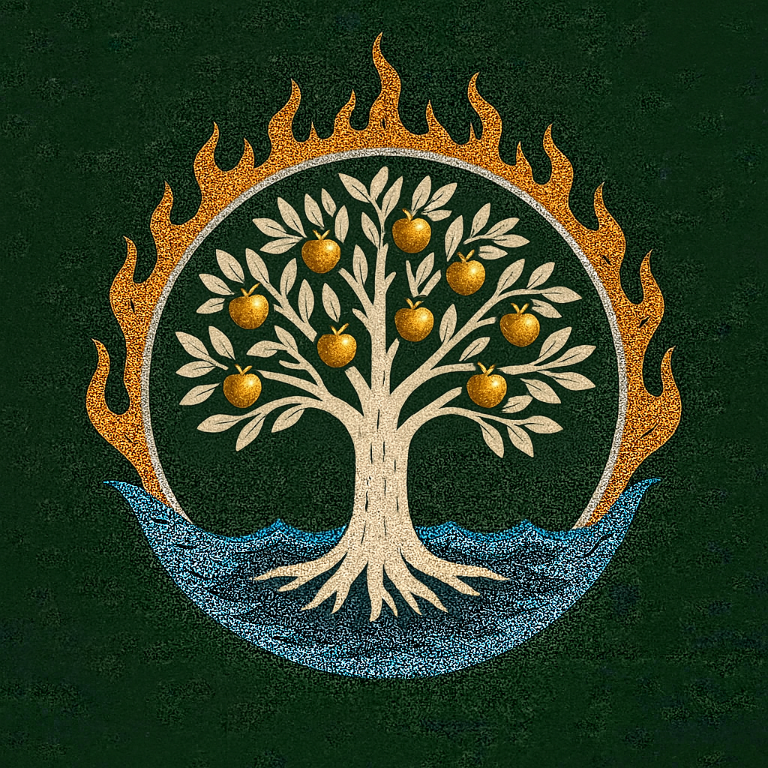
The Grovemark
Seal of Alignment
The Arcadian Grovemark is the symbol you will see on this site and on the land itself. It gathers the Accord into a single emblem: an apple tree, ring of fire and water, golden fruit, circle, and green field.
It is not a brand of ownership. It is a sign that in this place, the Accord is honored, the elements serve life in harmony, and the culture is bearing good fruit for those alive now and those yet to come.
Rites and rhythms
Arcadia is held together by more than plans and structures. It is held together by repeated acts that tune people to the land and to one another.
Across the year, the great markers return like steady drumbeats.
At the solstices and equinoxes, the tribe gathers in the Grove or by the Stillwaters. Fires are lit. Bread is broken. Songs, prayers, and vows are spoken aloud. Planting, harvest, first frost, and thaw are all named and honored so that the work of the year never feels random.
Life passages are marked in the same way. Births are welcomed with blessing. Children crossing into new responsibility are given visible tasks and a circle of witnesses. Lovers who bind their lives together do so before land, fire, and tribe. The dead are named, remembered, and released.
Between these high points are the smaller rhythms that make a culture real.
Weekly evenings for shared story, song, or study. Regular times for martial practice and physical training so the tribe is able to defend what it loves. Quiet nights by the hearth where craft, mending, and simple talk loosen the knots of the week.
These rites are not performances for an audience. They are ways of keeping memory fresh, gratitude alive, and courage in motion. They remind each person that they stand inside a story that began before them and will continue after they are gone.
Arcadia is not built for a narrow type of person. It is built for those who can live by the Accord.
Belonging here is not about bloodline, trend, or ideology. It is about willingness.
The people who belong in Arcadia are those who:
• Want their lives tied to a real piece of ground and a real circle of people.
• Are willing to work with their hands and accept the limits of the land.
• Can take responsibility for their choices and repair harm when they cause it.
• Desire to raise children, or support those who do, in a culture that values truth, courage, and service.
• Are ready to place the health of the land and tribe above personal convenience when those conflict.
Many paths of faith or philosophy can live here, so long as they fall in line with Natural Law, respect for sovereignty, and the no harm principle. No one is asked to abandon their conscience. Everyone is asked to live in a way that supports peace, health, and integrity.
Arcadia is not an escape from responsibility. It is a place where responsibility is taken up gladly, together.
Some will visit, learn, and return to their own homes, carrying part of the pattern back with them. Some will feel the deeper pull to stay, to apprentice themselves to the land and the people, and in time to swear the Accord.
Those are the ones Arcadia is being built for.
Who belongs in arcadia
The Call to Oath
To join Arcadia and live by the Accord, a person does not need to be flawless. They need to be willing to take responsibility. To learn old and new ways. To serve others and protect the land. To live these values in daily choices.
In time, this commitment is sealed through an oath made in the Grove, in the sight of land, tribe, and fire. This is not an oath to an institution. It is an oath to a way of life.
If Arcadia is the body, the Accord is its spine. To understand the Grove, you must meet the Accord.